
Automatic packaging machines keep perishable foods airtight by controlling seal temperature, contact pressure, dwell time, package atmosphere, and film position within repeatable production settings. A 2023 food-packaging line running 60 packs per minute can produce 28,800 packs during an 8-hour shift, so even a 0.5% sealing defect rate can affect 144 packs. Heat-sealable films generally work within material-specific temperature ranges, while vacuum and modified-atmosphere systems reduce or replace oxygen before closure. Seal contamination, wrinkles, worn jaws, or insufficient cooling can still create microleaks. Reliable sealing therefore depends on controlling the whole package-making process rather than simply heating two film surfaces together.
Airtight packaging starts before the sealing jaws touch the film. Meat, seafood, cheese, prepared meals, and bakery products can deteriorate through oxygen exposure, moisture transfer, microbial activity, or oxidation, and the package has to limit several of those processes at the same time. A line producing 40 packages per minute completes 19,200 packages in an 8-hour shift; a 1% process failure would produce 192 questionable packs. Production volume makes small differences in machine repeatability commercially important, which is why the first engineering question is usually whether the sealing material and machine have a sufficiently wide operating range.
Heat-sealing performance depends mainly on temperature, pressure, and contact time. Polyethylene, polypropylene, multilayer laminates, and barrier films do not soften and bond at identical temperatures, and manufacturers normally establish an acceptable sealing window through material and package testing rather than using one universal setting. Increasing a jaw from 130°C to 150°C, for example, may improve bonding for one sealant but distort another film. More heat does not automatically produce a better seal. Once the material range has been established, pressure becomes equally important because every millimeter across the sealing surface needs reasonably uniform contact.
A seal can look continuous from the outside while containing a narrow channel formed by a wrinkle, food particle, liquid droplet, or uneven jaw contact. Testing 100 finished packages can therefore reveal problems that temperature readings alone cannot show.
Uniform contact becomes harder when production speed rises. At 30 cycles per minute, a complete machine cycle lasts about 2 seconds; at 60 cycles per minute, only 1 second is available for forming, filling, sealing, cooling, cutting, and film movement where those functions share the cycle. Engineers cannot simply halve every process time when output doubles. Sealant layers need enough time under heat and pressure to form a bond, followed by enough cooling to resist mechanical stress, so high-speed equipment often uses multiple sealing stations, optimized jaw designs, or continuous-motion arrangements.
Cooling deserves particular attention because a newly formed heat seal does not instantly reach its final mechanical strength. A hot seal released too early can be stretched by package weight, conveyor acceleration, film tension, or downstream handling. On a line making 50 packs per minute, 24,000 seals are formed during an 8-hour production period. If insufficient cooling causes only 0.25% of them to open or weaken, 60 packages may require rejection or further inspection. Cooling control therefore leads naturally to another issue: the atmosphere trapped inside a perfectly closed package.
Vacuum packaging removes much of the air before closure and is widely used for meat, cheese, seafood, and processed foods. Normal atmospheric pressure at sea level is about 101.3 kPa, while industrial vacuum equipment reduces package pressure substantially below atmospheric conditions according to the product and package design. Removing air reduces the amount of oxygen initially enclosed, but low initial oxygen cannot compensate for a leaking seal. A package evacuated correctly and then closed across a contaminated sealing surface may regain air during storage, so evacuation and seal formation have to be treated as one sequence.
Modified-atmosphere packaging takes a different approach by replacing normal air, which contains about 20.9% oxygen and 78% nitrogen, with a selected gas mixture. Carbon dioxide, nitrogen, and sometimes oxygen are used according to food properties. Fresh red meat may require an oxygen-containing atmosphere to support the desired surface color, while many cheese and prepared-food applications use mixtures intended to limit aerobic spoilage. Gas percentages cannot be selected from a generic chart alone because product composition, storage temperature, headspace volume, microbial conditions, film permeability, and expected shelf life all affect the result.
| Process variable | What the machine controls | Example production consequence |
|---|---|---|
| Seal temperature | Heater output and jaw temperature | A 5–10°C departure may move some films outside their validated range |
| Dwell time | Duration of jaw contact | At 60 cycles/min, total cycle time is about 1 second |
| Vacuum | Air removal before sealing | Lower residual air reduces initial package oxygen |
| MAP gas | Gas composition and flushing | Normal air begins at about 20.9% O₂ |
| Film position | Registration and web movement | A 2–3 mm shift can place a seal outside its intended area |
| Reject rate | Failed-pack removal | 0.5% of 20,000 packs equals 100 rejected packs |
Atmosphere control only remains useful when the packaging material can retain it. Multilayer food films may combine a structural layer, a heat-sealable layer, and an oxygen-barrier material such as EVOH. Packaging specifications commonly report oxygen transmission rate and water-vapor transmission rate because gas can enter through the film itself even when the perimeter seal has no leak. Comparing two films only by thickness can therefore be misleading: a 70 μm multilayer structure may provide different oxygen protection from another 70 μm film made from a different polymer combination.
Film performance also changes with package geometry. A tray with a large surface area exposes more material to gas transmission than a small pouch made from the same film, while sharp bones or hard product edges can introduce puncture risks unrelated to the seal. A manufacturer testing 200 packages may therefore examine both perimeter sealing and body integrity rather than assuming one test represents the complete package. Material selection then connects directly with contamination control because even a high-barrier laminate cannot compensate for food sitting between the two surfaces being sealed.
Liquids, oil, crumbs, powder, cheese fragments, meat juice, and product fibers can interrupt the seal interface. Automated fillers reduce the problem by coordinating dosing with package position and leaving a defined clean area for sealing. Suppose a machine fills 15,000 pouches per shift and product contamination reaches the seal area in 0.8% of cycles; 120 packages may require inspection before considering any other defect source. Fill timing, nozzle height, splash control, package dimensions, and product settling therefore affect airtightness even though none of them belongs to the heater itself.
Seal contamination is often a placement problem rather than a temperature problem. Raising the jaw temperature cannot reliably repair a seal when sauce, oil, powder, or a folded film layer prevents the two sealant surfaces from making proper contact.
Film tracking is another mechanical source of defects. Registration sensors read printed marks while servo-controlled rollers position the web for filling, sealing, and cutting. If a pouch has a designed 10 mm sealing band and lateral film movement consumes 3 mm of that area, the remaining usable width falls by 30%. Wrinkles can make the situation worse because several layers may overlap at one location while another location receives insufficient contact. Web tension, guide alignment, roller condition, and registration settings consequently need attention alongside the sealing recipe.
Mechanical condition matters for the same reason. A sealing jaw can display 145°C while one section transfers heat poorly because of residue, a worn pad, damaged coating, or heater irregularity. When failures repeatedly appear at approximately the same position on 50 or 100 sampled packages, technicians can compare that location with the corresponding jaw surface. Preventive maintenance schedules commonly include cleaning, jaw inspection, heater checks, sensor verification, pneumatic inspection, and replacement of wear components rather than waiting until packages begin leaking at a noticeable rate.
Sensors reduce dependence on occasional manual checks. Modern machines can monitor temperature, vacuum pressure, compressed-air supply, gas pressure, film registration, product presence, guard position, and cycle timing. A controller comparing a 150°C setpoint with continuous sensor feedback can identify a process departure much earlier than an operator inspecting one package every 30 minutes. If a line produces 45 packs per minute, that 30-minute interval represents 1,350 packages, showing why continuous process measurements are useful even when finished packages are still sampled.
Finished-package inspection addresses defects that machine settings cannot fully predict. Seal-strength testing measures the force required to separate bonded material, while leak testing asks whether a continuous passage exists through the package. The two measurements are not interchangeable: a seal may show acceptable average peel strength while one 1 mm channel permits gas movement. Vacuum-decay, pressure-decay, bubble-emission, burst, dye-penetration, and peel tests are selected according to package format and quality requirements, with sampling plans often covering multiple points during a production run rather than only startup samples.
A sample of 20 packs taken at startup describes those 20 packs. It does not prove that the next 20,000 packs will remain identical, which is why process monitoring and periodic package testing are normally used together.
Automated rejection adds another layer of control when inspection is performed online. A line operating at 75 packs per minute can make 36,000 packs during an 8-hour shift. At a 0.3% rejection rate, 108 packages leave the accepted product stream. Recording when and why those packages were rejected can reveal whether failures concentrate after film changes, cleaning, product changeovers, extended operation, or adjustments. Reject counts are more useful when connected to production time, machine settings, material batch, and package type instead of being recorded only as a daily total.
Changeovers deserve similar control because one machine may handle several products and packaging structures during the same week. Switching from a 60 μm film to an 80 μm laminate can change heat transfer, sealing time, tension behavior, and cooling requirements even when package dimensions remain similar. PLC recipe storage reduces manual entry by recalling approved parameters, but the first 10, 20, or 50 packages after a changeover can still be checked before full production continues. Material variation, jaw wear, product temperature, and moisture can prevent a stored setting from performing identically every day.
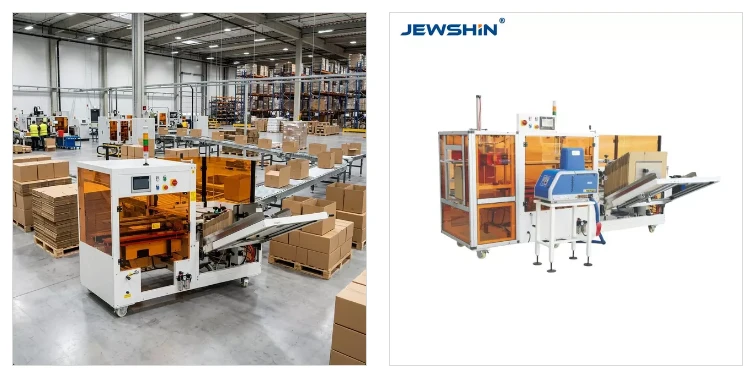
Secondary packaging affects the process after primary packages have passed their seal checks. Pouches, trays, or wrapped foods may move into corrugated cases before palletizing and distribution. An automatic carton erector forms shipping cartons consistently so primary packs can enter a case without operators repeatedly opening boxes by hand. At 20 cartons per minute and 12 food packs per carton, the downstream system must accommodate as many as 240 primary packs per minute; poor synchronization can create accumulation and mechanical pressure on recently sealed packages.
Case packing also explains why seal testing should reflect real handling conditions rather than only the moment a package leaves the sealing station. Packages may encounter conveyor transfers, compression inside cartons, pallet stacking, refrigerated storage, and road transport. Testing 100 packs immediately after production and another 100 after simulated handling can reveal defects that develop under stress. Flexible pouches containing hard or irregular foods deserve particular attention because package-body punctures can produce air ingress even when every heat seal remains intact.
Storage temperature introduces another variable. Refrigeration slows many deterioration processes, but packaging does not replace temperature control. A sealed refrigerated food stored at 4°C and the same product exposed to 10°C do not have equivalent microbial conditions, even if oxygen transmission and seal strength are identical. Shelf-life validation therefore considers the package, atmosphere, food formulation, handling, and expected storage range together. A 99.9% package pass rate has limited practical use if temperature management after packaging does not match the product specification.
Production teams can make the process easier to manage by separating measurable variables from assumptions. Temperature can be logged in °C, vacuum in kPa or mbar, gas composition as a percentage, seal strength in N/15 mm or another defined test format, and rejects as a percentage of total output. If 25 failures occur among 10,000 packages, the observed rate is 0.25%; repeating the same measurement after maintenance provides a comparable result. Numbers tied to defined test methods are more useful than describing a seal as merely “good” or “tight.”
Airtight performance finally depends on maintaining those measurements throughout production. A validated film, clean sealing area, stable temperature, uniform jaw contact, sufficient dwell and cooling time, controlled vacuum or gas composition, accurate web movement, maintained tooling, and appropriate leak testing each cover a different failure route. On a 2026 production line making 30,000 packages per shift, improving the defect rate from 1.0% to 0.2% reduces affected packages from 300 to 60 per shift, a difference of 240 packages before labor, food loss, packaging material, rework, or distribution costs are counted.